
Day 14 • September 20, 1994
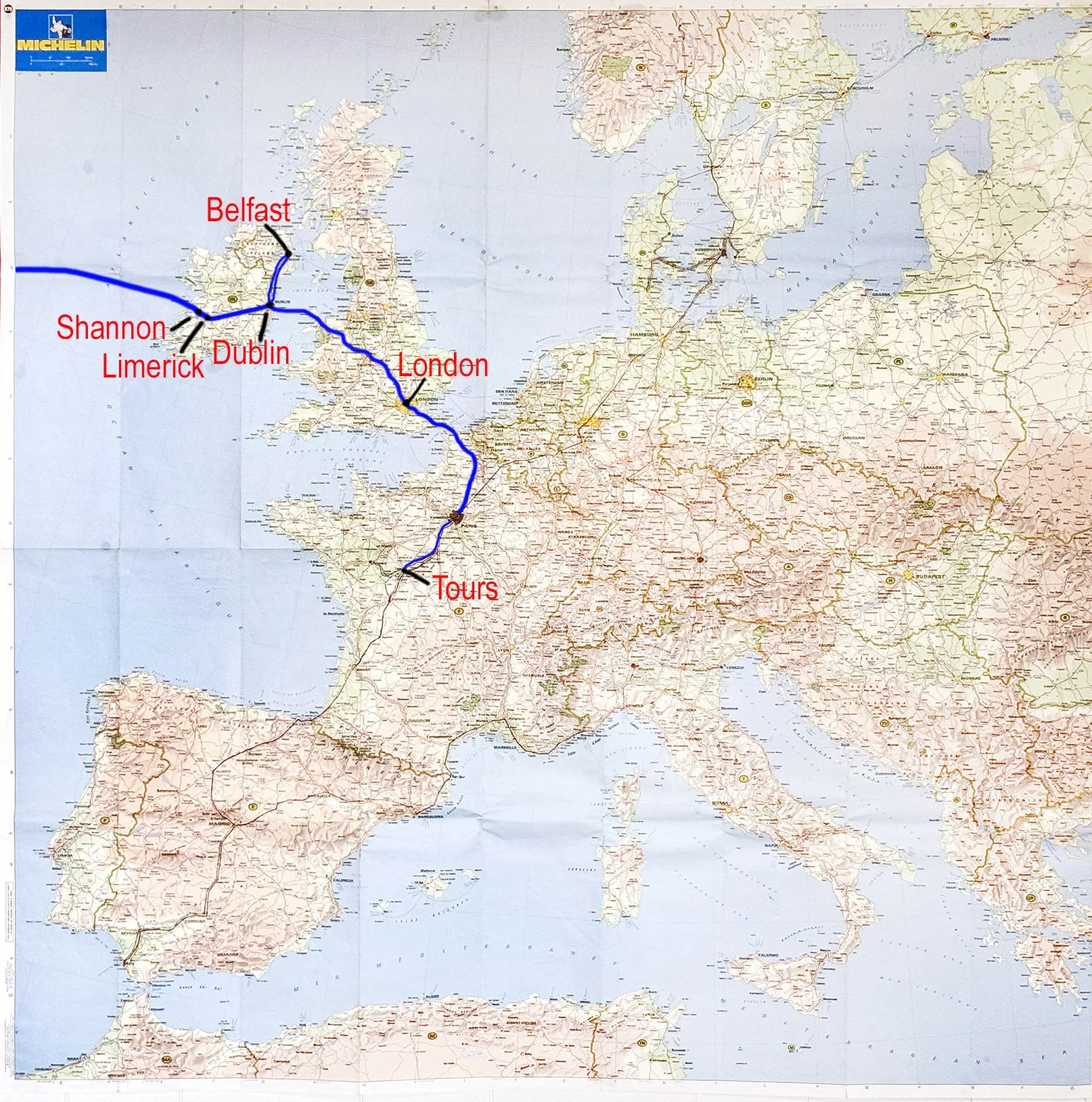
Tours, France
There’s a noticeable gap in my story. It is September 20, and I had not written in my journal since leaving London.
There are two simple reasons. First, I was having too much fun with Olivier to even stop and write. Second, I couldn’t find my journal. I knew I had it when I left London, but it had somehow disappeared. I hoped it would turn up soon. If not, I figured I’d buy another one and start over, but I really didn’t want to lose what I had already written.
Olivier had lived with my family as a Rotary exchange student in Kearney a few years earlier. He always told me I was welcome at his home, and here I was, living with him. It was a dream come true. We spent the week drinking French wine, smoking French cigarettes, eating incredible food, playing chess at Donald’s Pub, and staying up late talking with his friends. He was so happy I was there, and I fit right in.
Every afternoon I’d sit at a street-side café reading Le Monde while drinking incredibly strong coffee with cream and two cubes of sugar. It felt wonderfully French.
On this day, I put my missing journal out of my mind, picked up my camera and went exploring around Tours. I discovered the magnificent Cathedral of Tours and a building being demolished right in front of it. The stark contrast caught my eye, so I took several photographs. Then I became fascinated by the cathedral’s architecture and its many gargoyles.
I’m sure when my photo excursion was finished, I rendezvoused with Olivier and his girlfriend Rachel, and we spent the evening at Donald’s Pub with the gang, drinking, smoking and feeling oh-so-sophisticated and French.
Gargoyle On Watch
I looked up at the Cathedral of Tours and this ancient gargoyle caught my eye — fierce, weathered, and staring out over the city where it had been standing guard for centuries.
The contrast between the detailed stone creature in the foreground and the massive, intricate spires rising behind it was striking. Gargoyles were originally meant to ward off evil spirits, but in that moment it felt like this one was watching over my journey too.
My Photographs from today in Tours, France


A History Lesson
On September 1, 1944, near the end of World War II, at 3:35 a.m., Tours was liberated from the occupying Nazi forces. There was a month-long celebration in town during the month I was there, including this exhibit I visited.
This brochure says
“50 YEARS AGO… TOURS LIBERATED”
“Come and see how the people of Tours lived through the occupation, the liberation, and the reconstruction.”
FROM 1st TO 30th SEPTEMBER AT CITY HALL
The Municipality of Tours, with the support of the General Council, has decided to solemnly commemorate the 50th anniversary of its Liberation. Already on May 20th, a moving ceremony brought together at City Hall the rescuers and families of the 420 victims of the bombings suffered by the city.
This commemoration is supported by an exhibition, testimonies, and conferences. It aims to honor the memory of the deportees, the executed, the massacred, and the resistance fighters who saved the honor of France, often by giving their lives. It also seeks to illustrate the daily difficulties faced by our fellow citizens who, in the face of widespread shortages of food, clothing, and means of transportation, had to deploy extraordinary ingenuity — and sometimes sacrifice part of their meager rations — to ensure the survival of their children.
It also aims to show the immense amount of work that needed to be done in our city after the departure of the Germans. A city deprived of water, gas, and electricity, with destroyed roads and sewers.
The city was ravaged by fires set by German artillery in June 1940, and by Allied aerial bombings from 1942 to 1944. As a result, a large part of the population was crammed into unhealthy slums in Old Tours or in improvised barracks.
The people of Tours will thus better understand the difficulties that the successive Municipalities had to overcome after the Liberation to rebuild Tours into a great and beautiful city, loved by its inhabitants and admired by its visitors.
In addition to a remarkable vision of history, made possible by the loan of highly evocative documents and objects generously provided by collectors (whom I sincerely thank), and by the remarkable work carried out by the Municipal Archives Service, this commemoration will be a message of hope for today’s young people, many of whom know moments of discouragement when facing the difficulties of carving out their place in our society.
Jean Royer Deputy Mayor of Tours
The inside of the brochure says
September 1, 1944 … 3:35 am … Tours Liberated!
A powerful explosion destroys the bridge over the Vendée on the Cher River. They have finally left! "They," of course, are the Germans who had occupied the city for four years. In this late summer of 1944, the "Fridolins" are in retreat. August 1944 indeed marks the end of the German occupation in Touraine.
Very quickly, the rumor spreads. At dawn, those who are still sleeping are awakened by the wave of patriotic fever rising from all sides. Is it just a rumor? No, insist those who have walked the length and breadth of the city to proclaim the good news!
The tricolor flag, raised at the Prefecture at four o’clock in the morning, now flies from the balcony of the Hôtel de Ville. And for those who still have doubts, it is enough to walk through the streets to see a sea of blue, white, and red at every window.
The Germans have indeed left the city. Without wasting any time, the authorities from the Resistance emerge from the shadows. At 7:30 a.m., Jean Meunier and his team take up their positions at the Hôtel de Ville, and hundreds of residents of Tours gather in Jean Jaurès Square to cheer their liberators. At the same moment, on Rue Nationale, the German library is looted.
At 10 a.m., with a gaunt face, Robert Viver, the new Prefect of the Liberation, takes office.
All day long, it is nothing but an outpouring of emotion and popular joy. It is also the time for settling scores, with their excesses and abuses — for example, the women who were shaved, stripped naked in front of the Hôtel de Ville, and then hosed down with fire hoses. Tours, after 1,529 days of occupation, is liberated.
Exposition
From September 1 to 30, 1994, in the hall of the Hôtel de Ville (City Hall), an exhibition: “The Occupation, the Liberation, and the Reconstruction of Tours”
Open every day from 10 a.m. to 7 p.m. on weekdays and until 6 p.m. on weekends.
25 display panels illustrate daily life in Tours during the war, the situation in the city in 1939 (Tours was the provisional capital of France for three days), the exodus, the bombings, the rationing…
Numerous characteristic objects from this period are also presented in display cases. Among others, you will see military uniforms from the French, German, American, and English armies, as well as everyday items such as bicycles, radios, perfume, and an American cigarette pack.
Projections
“Tours During the War” & “Tours in 1947” (films by Jean Chauvin)
These documentary films will be screened throughout the entire duration of the exhibition.
Conferences
Thursday, September 15 at 8:00 p.m. General Rabaud “The Reconquest of the Skies of France”
Monday, September 19 at 8:00 p.m. Jean Chauvin “Cultural Life in Tours from 1939 to 1945”
Tuesday, September 27 at 8:00 p.m. Claude Groubois “Tours Under the Bombs of 1942 to 1944”
Looking Back from 2026
That week in Tours with Olivier remains one of the happiest stretches of my entire 100-day journey.
I barely took any photos. I didn’t write in my journal. I simply let myself disappear into the moment with my brother Olivier — drinking good wine, smoking too many cigarettes, playing chess at Donald’s Pub, and laughing with him, Rachel, and their friends late into the night. For the first time in a long while, I wasn’t trying to figure anything out. I was just living in the moment and loving it.
Looking back now, I can see how much I needed that week. After the intensity of Ireland and the emotional weight I’d been carrying, Olivier gave me permission to breathe and space to laugh. In fact, thinking back now at how much we laughed, I shake my head, smile and chuckle out loud. He gave me a taste of home in a foreign country, and he and his family really were my anchor abroad for this adventure.
When I finally picked my camera back up on September 20, I was drawn to the powerful contrast in front of the Cathedral of Tours — an ancient, majestic building standing beside the rubble of something being torn down. Those gargoyles especially spoke to me. Carved by hand over 800 years ago, they had watched generations come and go. They felt like silent witnesses.
That day marked the end of my “lost week” and the return to documenting the journey. But even more than the photographs, I cherish the memories of those carefree days with Olivier — a reminder that sometimes the most important moments aren’t the ones you capture on film, but the ones you simply live.