
The Camera
My Passport to the World
Long before I became a photographer, I was an artist.
As far back as I can remember, I loved to create things. I loved pencils and colored pencils, watercolor and acrylic paint. I took every art class I could, and while I enjoyed pottery and weaving, drawing and painting were where I felt most at home.
I loved taking something that existed only in my imagination and turning it into something I could see.
Then, in 1988, when I was 16 years old, I went to Australia as a Rotary exchange student.
That's where I discovered photography.
I was thousands of miles from home, seeing places I had never seen and meeting people I might never see again. I wanted to remember them.
So I started taking pictures.
And I fell in love with the immediacy of it.
I could capture a moment in seconds, take the film to a one-hour photo lab and have the photograph back that same day. A painting could take weeks. Photography could preserve a moment before the day was even over.
I was hooked.
Photography became my journal.
Instead of writing down everything I wanted to remember, I photographed it. People. Places. Experiences. Little moments that might otherwise have disappeared forever.

Exchange student life: Sailing on the Great Barrier Reef, drinking Fosters beer with Wayne Levings from South Africa in 1989.
I didn't know it then, but I had found the way I wanted to record my life.
When I returned home in 1989, I brought that discovery with me — along with a bag full of unexposed film.
I'd been taking pictures like crazy during my final weeks in Australia, but I was running out of money and couldn't afford to develop everything. So I brought the film home to Kearney.
When I walked into the one-hour photo lab and camera store at Bob's Superstore to drop it off, I noticed they were hiring.
Perfect.
I applied and got the job.
My boss was Ron Larson, who would later become mayor of Kearney. We always joked that we worked for Mayor Ron.
I was still a senior at Kearney High School.
And on the first day of my senior year, I met Tim Skrastins.
A few months later, Tim asked if he could get a job at Bob's, too. He needed to make some money for prom.
I told him, “Sure. Let me talk to Mayor Ron.”
And that's how Tim and I ended up working together.
We were high school seniors who loved photography, and before long, we started T&T Photography.
Neither of us had any idea where that little venture would lead us.
It became much more than a business. It became the beginning of a lifelong friendship and a shared love of photography that has lasted more than three decades.
Arlen Little was part of that world, too. Arlen was a college student at the University of Nebraska at Kearney, studying journalism and mass communications. He shared our interest in photography and storytelling, and before long, the three of us were spending a lot of time together.
Arlen also made sure I never got too full of myself.
He started calling me the world's second-best photographer.
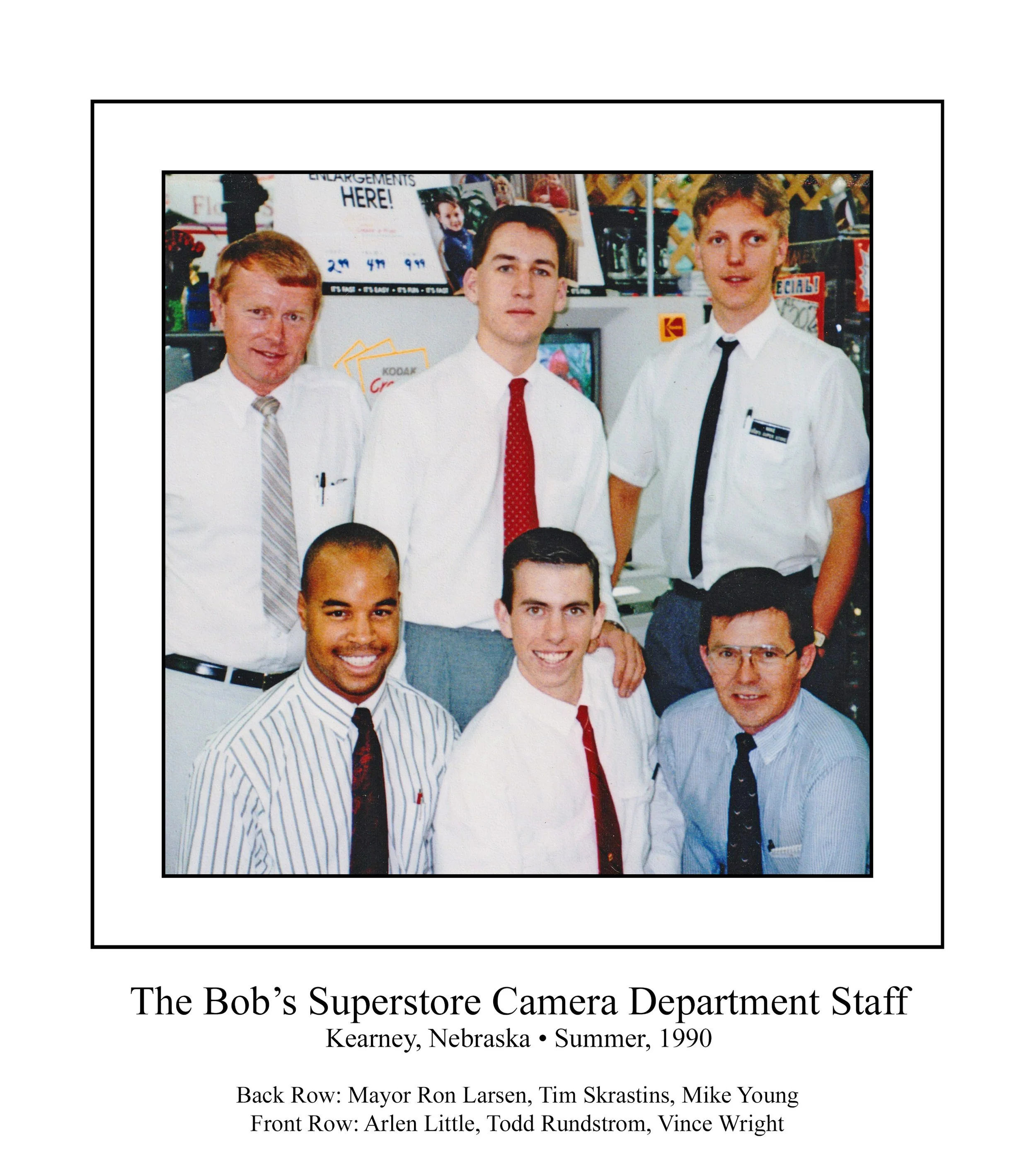
Looking back, Bob's was more than a job. It was where photography became part of my life.
Australia had given me the spark. Bob's gave me a place to learn.
Tim and I started taking pictures together. Then Arlen joined us. We were the three amigos - with cameras.
And in turn, my camera became something I carried into the world with me wherever I went.
It gave me permission to approach strangers.
“Can I take your picture?”
That question could open a door.
I wasn't always comfortable walking up to people, but with a camera in my hands, I had a reason to be curious. I could enter someone's world for a moment, connect with them and leave with a photograph.
The camera became my shield of protection and my magic wand of permission.
It also taught me to look. To notice the light. The expression. The fleeting moment. To stop when everyone else was walking past. By 1994, I understood what the camera could do and the magic I could create with it.
I had already been paid to photograph portraits, weddings and commercial assignments with Tim. We even had a studio in Downtown Kearney, on Central Avenue, in a beautiful loft on the second floor of a historic two-story brick building above a law firm.
So when I left for Europe at 22, I didn't think of bringing my camera as an afterthought.
It was my passport to experience Europe.
I carried it everywhere — onto trains and airplanes, into hostels and pubs, across borders and down unfamiliar streets.
And I photographed everything I thought I might never see again.
Some of those photographs are technically good. Some aren't. Some are crooked, blurry or poorly exposed. I don't care.
They show what I saw. They show who I was. And they captured a young man who had no idea what his life was going to become.
Thirty-two years later, those photographs have become something I never could have imagined when I made them.
They are a doorway.
I can look at one and suddenly I'm there again — remembering a smell, a face, a conversation, a feeling. Sometimes the photograph brings back something I didn't even know I'd forgotten.
That's why these photographs matter.
They're not just souvenirs. They're pieces of my life.
And now, looking at them from the other side of three decades, I'm not just revisiting Europe.
I'm meeting the kid who took them.
He was 22. He was curious, scared and excited. He was trying to figure out where he belonged. He didn't know where the journey would take him. He didn't know what he would find. He didn't know how the story would turn out.
He only knew that the world was out there and he wanted to see it.
So he picked up his camera. And he went.